
The cheapest quote is rarely the cheapest supplier
Unit price is the one cost a buyer can see before anything ships. Everything else stays hidden until it's too late to renegotiate — which is exactly where Hunar Global earns its place.
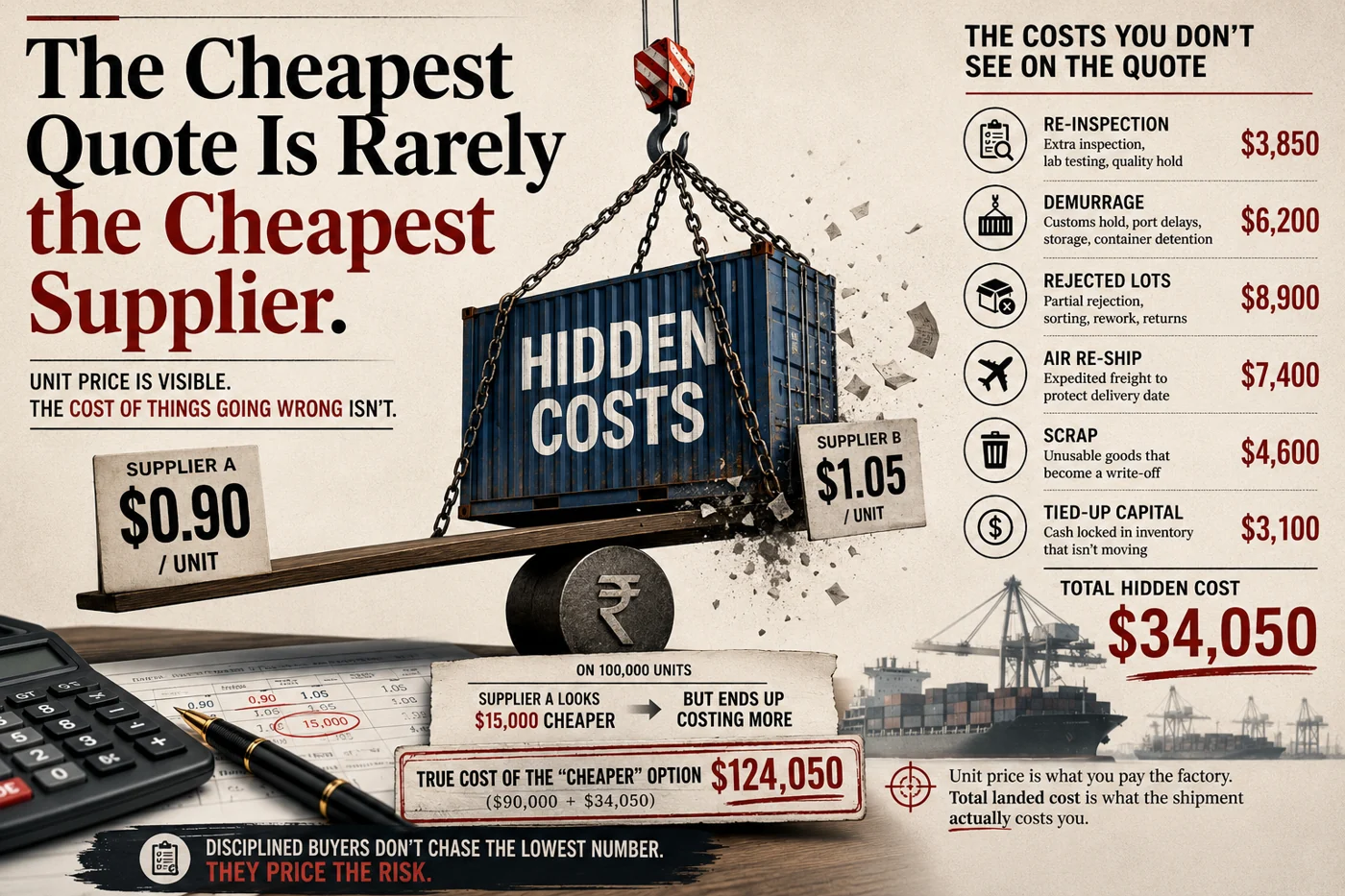
When a buyer sources medical products from India, the process usually starts the same way: collect quotes, line them up in a spreadsheet, and let the lowest unit price move to the top of the list.
It's a reasonable instinct. It's also where a great deal of procurement risk gets quietly bought.
Unit price is the one cost that's visible before anything ships. Everything else — the cost of things going wrong — stays hidden until it's too late to renegotiate. And in medical sourcing, “wrong” has a long tail:
- A lot that fails incoming inspection and has to be sorted or sent back.
- Re-testing that was never budgeted for.
- A documentation error that holds the shipment at customs, accruing demurrage by the day.
- An expedited air re-ship to protect a delivery date the delay just threatened.
- A non-conformity that can't be reworked at all, and simply becomes scrap.
- Working capital sitting inside a container that isn't moving.
None of these appear on the quote. All of them land on the buyer.
A worked example — illustrative
Consider two suppliers. Supplier A quotes $0.90 a unit; Supplier B quotes $1.05. On 100,000 units, A looks $15,000 cheaper — and on the spreadsheet, the decision makes itself.
Now suppose A's lot arrives with a defect rate high enough to trigger a partial rejection, a re-inspection of the balance, and a two-week customs hold while a certificate is corrected — and, to protect the launch date, part of the order has to move by air. It doesn't take much of that before the $15,000 “saving” is gone, and Supplier B — the more expensive quote — would have been the cheaper supplier.
That's the difference between unit price and total landed cost. Unit price is what you pay the factory. Total landed cost is what the shipment actually costs by the time it's cleared, inspected and usable on the shelf — including the price of everything that didn't go to plan.
The most disciplined buyers don't chase the lowest number. They price the risk, asking a different question of each supplier — not “what does a unit cost?” but “what does a failure cost here, and how likely is it?”
How Hunar Global approaches it
We source against total landed cost, not the headline quote. Supply is vetted, documentation is aligned to the destination, and the failure modes that would otherwise surface as demurrage, rejected lots or air re-ships are managed out before they reach the buyer. Sourcing from India rewards that discipline, because the range between suppliers is wide — and the gap between the cheapest quote and the most reliable one is often the whole game.
Have a sourcing requirement?
Tell us the product, the market and the standard it must meet — we coordinate the rest, from India to your dock.