Customs doesn't inspect your product. It inspects your paperwork.
A medical shipment rarely gets held because something is wrong with the product. It gets held because something is wrong with the documents — which is why Hunar Global prepares them for the destination, not just the departure.
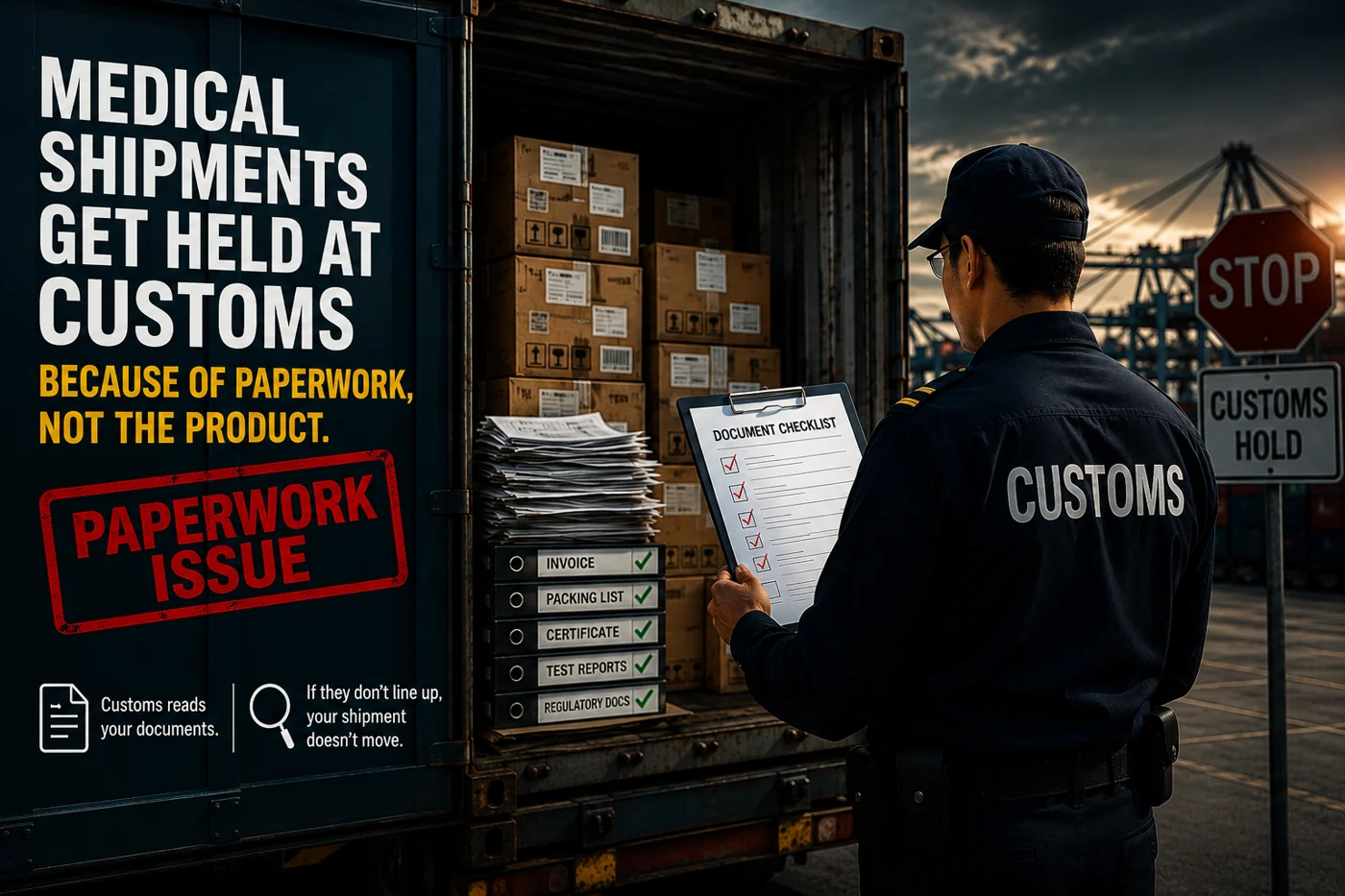
A medical shipment rarely gets held at customs because something is wrong with the product. It gets held because something is wrong with the paperwork.
That distinction matters more than most buyers expect. Customs officers don't test the device — they read the documents. And if the documents don't line up, with each other and with the destination country's requirements, the container waits while demurrage runs and the delivery date slips.
Here's where medical shipments most often get stuck. None of it is exotic; all of it is preventable before goods leave India.
- 01The description doesn't match across documents.
The commercial invoice, packing list and certificates say slightly different things — a product name here, a quantity there. Customs reads inconsistency as a red flag and stops to resolve it.
- 02The HS code is wrong.
Misclassify the product and you get the wrong duty, a query, sometimes a penalty. The right code is a decision, not a guess — and the buyer lives with the consequences.
- 03The regulatory documentation is for the wrong market.
A product cleared for one destination isn't automatically cleared for another. The conformity evidence — CE, the destination regulator's approval, whatever applies — has to match where the goods actually land.
- 04The labelling or instructions-for-use don't meet local rules.
Wrong language, missing symbols, absent identifiers. In medical, labelling is a regulatory requirement, not a formality — and it's checked.
- 05Sterile or batch-specific documents are missing.
No sterilization validation, no certificate of analysis, no batch records where they're required. These aren't optional paperwork; they're the proof the product is what was ordered.
The pattern underneath all of these is the same: the paperwork was prepared to leave India, not to enter the destination country. Those are two different jobs.
The buyers who rarely get stuck do one thing differently. Before anything ships, they align the documentation to the destination — not the origin — and decide explicitly who is responsible for each document. Not “the supplier handles export docs,” but: which document, prepared by whom, checked against whose requirements.
Customs doesn't inspect your product. It inspects your paperwork.
How Hunar Global approaches it
Preparing documentation to enter the destination — not merely to leave India — is central to how we work. Commercial documents, certificates of origin, market-specific regulatory paperwork and sterility records are aligned to where the goods actually land, with clear ownership of each document, so shipments clear on schedule instead of sitting at port.
Have a sourcing requirement?
Tell us the product, the market and the standard it must meet — we coordinate the rest, from India to your dock.